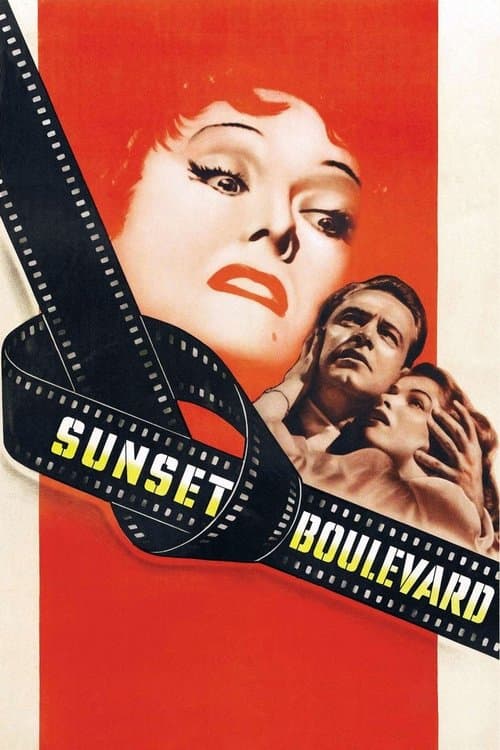
For episode 6 we went back to 1950 for Sunset Boulevard, Billy Wilder's noir about Norma Desmond, a former silent-film star played by Gloria Swanson, and Joe Gillis, the down-and-out screenwriter played by William Holden who gets pulled into her orbit after hiding his repossessed car in her garage. Matt gave it a five. Jeff landed at four and a half.
Nobody's clean in this one
What stuck with both of us was how hard the movie makes it to pick a side. Norma draws real sympathy chasing a comeback, until every time she talks about it she sounds a little more delusional. Joe is using her for money. Max the butler, who turns out to be her ex-husband, keeps the delusion going by writing her fake fan mail. The closest thing to a clean conscience is Betty, the young studio reader Joe starts secretly writing a screenplay with, and even that relationship isn't uncomplicated: he's cheating on his fiancée to do it.
A line that kept pulling us into real stories
Early on, Joe tells Norma she used to be big. She answers, "I'm still big. It's the pictures that got small." That line sent both of us somewhere else. Jeff had just watched Ben Affleck, on a media tour, describe how people who vanished from his life during his career slump reappeared once he found success again with Argo, and how his first instinct was anger before his agent talked him into some grace. Matt matched it with an older one: a 2004 Larry King interview he remembered with Gene Hackman, two Oscars deep into a career full of classics, telling King flatly he didn't have a next project lined up and that it was "probably all over." Norma, worth a million dollars and still getting a warm nod from Cecil B. DeMille himself on the Paramount lot, is the same gap taken to its extreme: respect for what you did, nothing for what you might do next.
We didn't fully agree on whether the line still holds. Matt tied it to Scorsese's old complaint that Marvel movies aren't cinema, just money, and admitted he's torn: he gets the impulse to defend the art, but he's also sat through enough of the silent era to know it wasn't all better before. Jeff's take leaned more toward an industry cycle: there was a stretch, maybe a decade back, where a studio could pump out something like Transformers 4, bank on it printing money in China regardless of quality, and not worry whether it was good. He thinks the pendulum has swung back toward more ambitious films since, so the line reads less like a timeless truth and more like something that's true in some eras and not others.
Where we landed
Matt gave it a five out of five, and picked out the shot of Norma standing in the projection room, lit by the flicker of her own old movie while she rants about her comeback, as one of the best in the film. He also pointed out that Gloria Swanson's card-playing friends in the movie are real silent-era veterans, Buster Keaton among them, playing faded versions of themselves.
Jeff landed at four and a half, reading the film as being less about one woman's breakdown and more about how Hollywood can make someone and then discard them. He thought Swanson's performance was intentionally over the top for the role rather than just dated, and that the one real mark against an otherwise engaging watch is Joe cheating on his fiancée along the way.