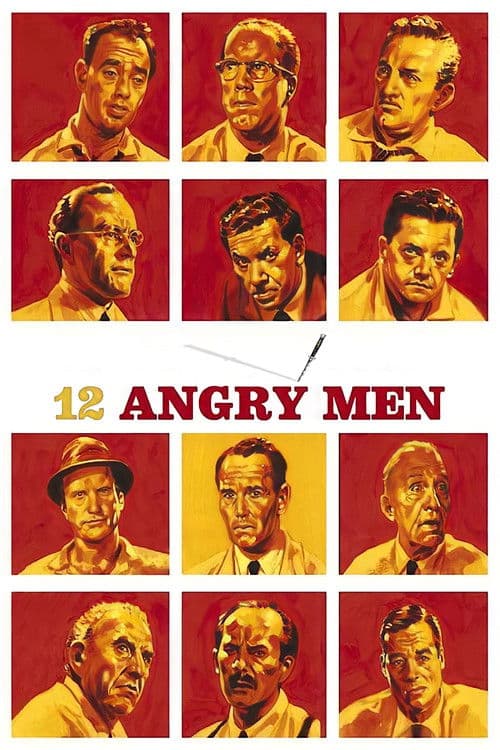
For episode 9 we went back to 1957 for 12 Angry Men, Sidney Lumet's courtroom-adjacent drama about a single holdout juror. We both landed on a five out of five, no debate needed.
The backstory surprised us both. Reginald Rose originally wrote it for live television on CBS before it became a stage play and eventually this film, with Henry Fonda producing and hiring Lumet, who up to that point had only directed for TV. The movie earned three Oscar nominations and lost all three, to The Bridge on the River Kwai, a film neither of us has seen yet but has clearly earned a spot on the list. It even flopped on its original theatrical release before becoming the classic it is now, strong enough to get remade in 1997 with Jack Lemmon and George C. Scott.
Early Sorkin, decades before Sorkin
Jeff kept coming back to how modern the dialogue felt, with bursts of fast, tense exchanges that reminded him of an early Aaron Sorkin script. He also dug into the cinematography: a seven-minute unbroken take to open the jury room scene, and a deliberate camera progression from high, wide angles early in the deliberations down to low, tight, eye-level shots as tempers rise, before pulling back out again by the end. Matt drew his own comparison to Citizen Kane's deliberate camera placement, and was most struck by how distinct all twelve jurors stay throughout, never collapsing into one generic voice. He singled out Lee J. Cobb's Juror 3 as a standout against Henry Fonda's almost eerily calm Juror 8.
Could this jury happen today?
Both of us kept circling back to the title. Not everyone in that room is equally angry, but there are real flashes of people treating each other like jerks, loudly and passionately, without it tipping into the physical violence we've come to expect from modern conflict. Jeff admitted that's part of what makes the film feel like a snapshot of a different era: watching it, you half-expect a shove or a punch that never comes. Matt wondered whether a real 1957-style jury, with eleven guilty votes softening into reasonable doubt over the course of an hour, is even realistic by today's standards, or whether it would end in a hung jury or mistrial instead. Either way, we landed on the same place: this is required viewing for how to disagree well, something Jeff said more than once he wished more of the country's current political discourse looked like.
A couple of plot details stuck with each of us. Matt pointed to the knife: the prosecution's murder weapon is treated as one-of-a-kind, until Juror 8 produces an identical one he picked up at a pawn shop the night before. Jeff kept thinking about the three-a.m. detail, the question of why the defendant would come home at that hour if he hadn't actually been at the movies as he claimed. And we both singled out Juror 10's bigoted rant late in the film, and the moment the other jurors silently stand and turn their backs on him, as one of the most quietly devastating scenes in the movie.
Matt also recommends picking up Sidney Lumet's book Making Movies if you want more from the director behind this one. 12 Angry Men is widely available to stream. Hear the full conversation, along with our Obsession review and our top five screenplays of all time, on episode 9.